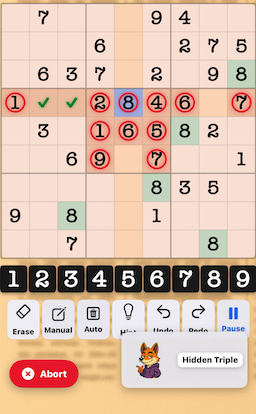
What is a Hidden Triple?
A Hidden Triple occurs when three candidates appear only in three cells within a unit, even though those cells may contain other candidates as well. The three candidates are "hidden" amongst other possibilities.
Unlike Naked Triples where the cells contain ONLY the three candidates, Hidden Triples have extra candidates that can be eliminated once the pattern is identified.
Hidden Triple vs Naked Triple
Hidden Triple
Three candidates appear ONLY in three cells
Cells may have other candidates
Eliminate OTHER candidates from the three cells
Naked Triple
Three cells contain ONLY three candidates
No extra candidates in the cells
Eliminate the three candidates from OTHER cells
How to Find Hidden Triples
Step-by-Step Process:
- Choose a unit: Select a row, column, or box to analyse
- List missing numbers: Identify which numbers still need to be placed
- Track candidate locations: For each missing number, note which cells can contain it
- Find restricted candidates: Look for three numbers that appear only in the same three cells
- Make eliminations: Remove all OTHER candidates from those three cells
Example Analysis
Finding a Hidden Triple
Consider a box where candidates 2, 5, and 8 can only appear in cells A, B, and C:
- Cell A: {1, 2, 5, 7}
- Cell B: {2, 5, 8, 9}
- Cell C: {3, 5, 8}
Hidden Triple found! Candidates {2, 5, 8} appear only in these three cells.
Elimination: Remove 1, 7 from Cell A; remove 9 from Cell B; remove 3 from Cell C.
Result: Cell A: {2, 5}, Cell B: {2, 5, 8}, Cell C: {5, 8}
Why Hidden Triples Work
If three numbers can only go in three specific cells within a unit, then those three cells must contain exactly those three numbers (one per cell). Any other candidates in those cells are impossible and can be safely eliminated.
Spotting Hidden Triples
Tips for finding Hidden Triples:
- Focus on candidates that appear in few cells (2-3 cells)
- Look for candidates that share the same limited set of cells
- Check if three such candidates all appear in exactly three cells
- Hidden Triples are often easier to find in boxes than in rows/columns
Common Challenges
- Harder to spot: The extra candidates make Hidden Triples less obvious than Naked Triples
- Requires tracking: You need to track where each candidate can appear in the unit
- Partial appearances: Not all three candidates need to appear in all three cells
Ready to Practice?
Download SudokuWorldTournament and master Hidden Triples!
Download Free on App Store