What is Classic Sudoku?
Classic Sudoku is a number-placement puzzle that combines logical reasoning with pattern recognition. The puzzle consists of a 9×9 grid divided into nine 3×3 boxes. Some cells contain given numbers, and your goal is to fill in the remaining empty cells using pure logic—no guessing required.
What makes Sudoku fascinating is its perfect balance: the rules are simple enough to learn in minutes, yet the puzzles can range from gentle warm-ups to mind-bending challenges that test even the most experienced solvers.
The Three Fundamental Rules
1 Each Row Must Contain 1-9
Every horizontal row in the 9×9 grid must contain all digits from 1 to 9 exactly once. No number can appear twice in the same row, and no number can be omitted.
2 Each Column Must Contain 1-9
Every vertical column in the 9×9 grid must contain all digits from 1 to 9 exactly once. Just like rows, no number can repeat within a column, and all nine digits must be present.
3 Each 3×3 Box Must Contain 1-9
The 9×9 grid is divided into nine 3×3 boxes (sometimes called blocks or regions). Each of these boxes must contain all digits from 1 to 9 exactly once, with no repetitions.
This third rule is what makes Sudoku truly challenging and interesting. A number might be valid for a particular row and column, but if it creates a duplicate in its 3×3 box, it cannot be placed there.
How to Play: A Practical Example
Solving Your First Cell
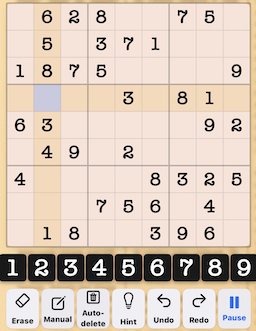
Let's examine the blue highlighted cell in this puzzle. To determine what number goes here, we need to apply all three Sudoku rules systematically.
Step 1: Check the Row
Looking at the row containing our blue cell, we can see it already has certain numbers. Our cell cannot be any of those.
Step 2: Check the Column
Scanning down the column, we find more numbers already placed. So our cell also cannot be any of those.
Step 3: Check the 3×3 Box
The blue cell is in a 3×3 box that already contains some numbers. Therefore, our cell cannot be any of those either.
What Makes a Good Sudoku Puzzle?
🎯 Unique Solution
There is exactly one valid solution that can be reached through logical reasoning alone.
🧩 Minimal Clues
A quality puzzle provides the minimum number of given digits needed to guarantee a unique solution.
🎓 No Guessing Needed
Every step can be solved through logical deduction. You should never need to guess and backtrack.
⚖️ Balanced Difficulty
The puzzle difficulty should match its rating. Easier puzzles require only basic techniques.
Common Mistakes to Avoid
❌ Guessing
Never place a number because it "seems right." Every placement should be backed by logical certainty.
❌ Not Checking All Three Rules
Always verify that your number doesn't violate any of the three rules before placing it.
❌ Ignoring Given Numbers
The puzzle's given numbers contain crucial information. Always refer back to them when analysing.
❌ Rushing Through
Even in easy puzzles, take a moment to verify each placement. Accuracy beats speed every time.